The Campaign That Looks Like the Winner
Open a Google Ads or Meta Ads account and it is easy to identify the campaign that appears to be winning.
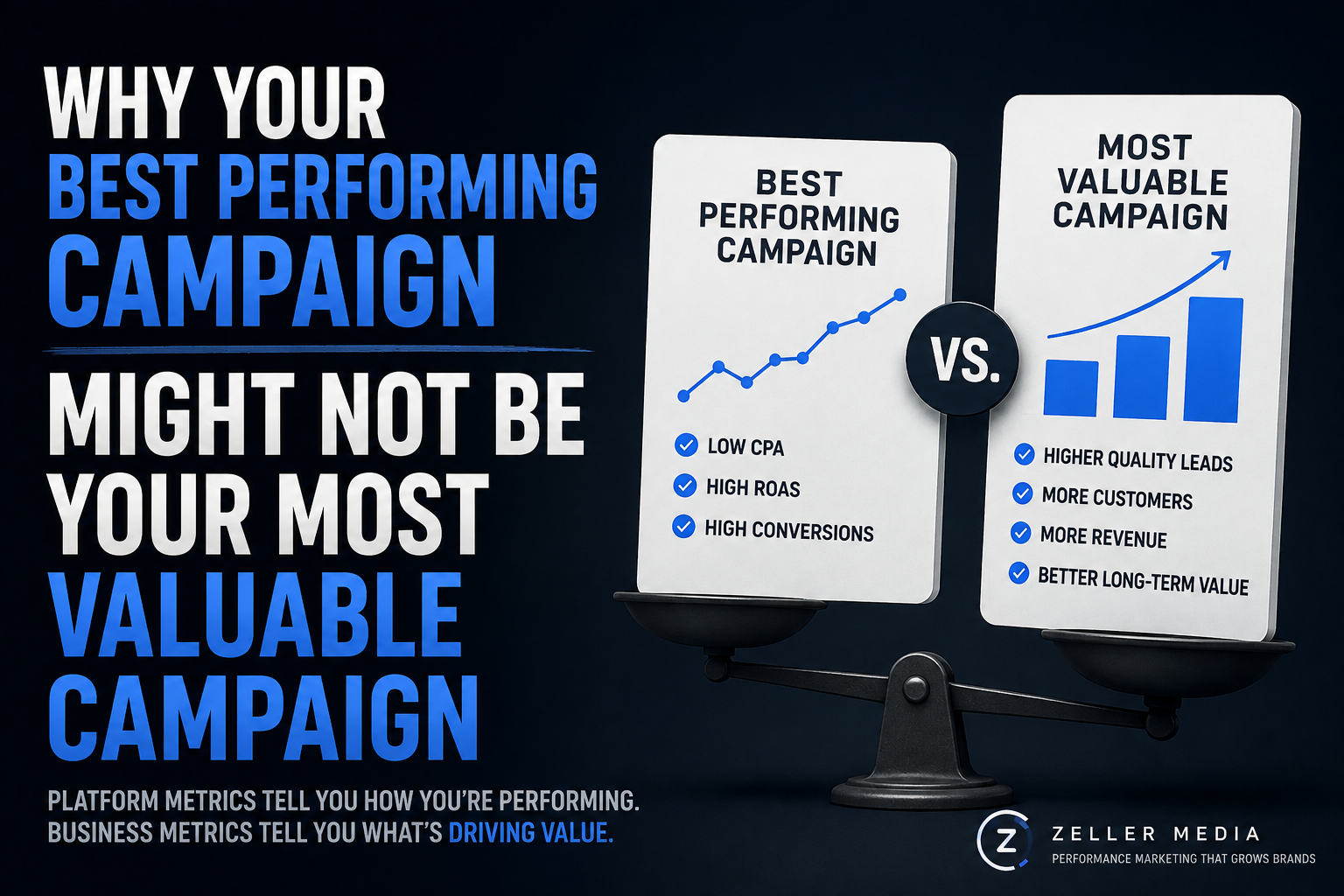
It has the lowest CPA.
The highest ROAS.
The strongest conversion rate.
Maybe it even generates the most conversions.
So the natural conclusion is:
Give that campaign more budget.
Sometimes that's the right decision.
But sometimes, the campaign that looks best inside the advertising platform isn't the campaign creating the most value for the business.
Because efficiency and value aren't the same thing.
A campaign can be extremely efficient at generating conversions while producing customers who are worth less, have lower close rates, or represent demand that would have existed anyway.
That's why looking at the campaign with the best numbers isn't always enough.
A Conversion Isn't a Uniform Unit
One of the biggest mistakes in paid media is treating every conversion as if it has the same value.
Imagine two campaigns.
Campaign A generates 100 leads at $50 per lead.
Campaign B generates 50 leads at $80 per lead.
If we're optimizing for CPL, Campaign A clearly wins.
But now imagine that only 20% of Campaign A's leads become customers, while 50% of Campaign B's leads become customers.
Suddenly, the picture changes.
Campaign A generated more leads.
Campaign B generated fewer leads.
But Campaign B may be generating substantially more customers from the money being invested.
The same principle applies to revenue and customer value.
A campaign generating inexpensive conversions isn't necessarily creating inexpensive customers.
The conversion is only the beginning of the analysis.
Your Platform Metrics Don't Tell the Whole Story
Google Ads and Meta Ads provide incredibly useful information.
CPC.
CTR.
Conversions.
CPA.
ROAS.
Conversion rate.
These metrics are essential for managing campaigns.
But they primarily tell you what happened inside the advertising system.
They don't necessarily tell you what happened after the conversion.
Did the lead answer the phone?
Did they qualify?
Did they become a customer?
How much revenue did they generate?
What's their lifetime value?
Did they become a new customer or were they already familiar with the business?
Those questions require information beyond the advertising platform.
That's where CRM data, offline conversions, analytics, and revenue reporting become important.
The Campaign With the Highest ROAS Can Be the Wrong Campaign to Scale
A company searches for its own brand name.
Your ad appears.
They click.
They convert.
Google attributes the conversion to your campaign.
The campaign generates a fantastic ROAS.
There is nothing inherently wrong with that.
Branded search can be extremely valuable.
But there is a fundamental difference between capturing existing demand and creating incremental growth.
If people already know your company and are actively searching for it, the campaign is primarily capturing demand that already exists.
Now compare that with a non branded campaign targeting someone searching for a category, service, or problem without already knowing your business.
That campaign may produce a lower ROAS.
It may have a higher CPC.
It may have a higher CPA.
But it could also be responsible for introducing your company to customers who would not have found you otherwise.
So which campaign is more valuable?
The answer isn't automatically the one with the higher ROAS.
Efficiency vs. Business Value
This is the distinction advertisers need to understand.
Efficiency asks:
How cheaply and effectively did this campaign gene
rate the conversions we're measuring?
Business value asks:
What did those conversions ultimately mean for the business?
Those are related questions, but they're not identical.
A campaign can be highly efficient without having unlimited growth potential.
Another campaign can be less efficient while creating access to a much larger pool of potential customers.
That's why simply sorting campaigns by ROAS and allocating budget from top to bottom can lead to poor strategic decisions.
What Happens When You Add CRM Data?
This is where campaign evaluation becomes much more interesting.
Suppose you're running lead generation campaigns.
Campaign A:
$50 CPL
20% qualified lead rate
10% close rate
Campaign B:
$80 CPL
50% qualified lead rate
30% close rate
If you're only looking at CPL, Campaign A wins easily.
But once you follow those leads through the sales process, Campaign B may be dramatically more valuable.
The same principle applies to businesses where phone calls are a major part of the sales process.
A campaign can generate hundreds of calls, but the important question isn't necessarily how many people called.
It's:
How many qualified opportunities did those calls create?
And then:
How many of those opportunities became customers?
And ultimately:
How much revenue did those customers generate?
That's how campaign performance starts becoming business performance.
New Customers Can Be More Valuable Than Existing Demand
Another important distinction is who you're acquiring.
Not every conversion represents a new customer.
Some may come from existing customers.
Some may come from people who already know the brand.
Some may come from people who were already searching specifically for the business.
Some may come from entirely new audiences.
These customers can have very different strategic value.
For an ecommerce business, acquiring a new customer may be more valuable than generating another purchase from an existing customer.
For a lead generation business, a qualified prospect who becomes a long term customer can be worth substantially more than a low quality lead that never closes.
This means campaign evaluation should consider customer acquisition, not simply conversion acquisition.
The “Worst” Campaign May Actually Be Your Growth Engine
This is one of the counterintuitive parts of paid media.
Imagine one campaign has:
8x ROAS
and another has:
2.5x ROAS
It is tempting to immediately conclude that the first campaign deserves more money.
But what if the 8x campaign is already close to its maximum available demand?
You can't simply multiply the budget by five and expect five times the revenue.
Meanwhile, the 2.5x campaign may be targeting a much larger market and bringing in customers who weren't already looking for your brand.
The second campaign may have substantially more room to scale.
In that situation, the lower ROAS campaign could actually be more strategically valuable.
The question isn't:
“Which campaign looks best?”
It's:
“Which campaign gives the business the best opportunity to grow profitably?”
This Doesn't Mean ROAS Doesn't Matter
ROAS is still an important metric.
So is CPA.
So is CPL.
So is conversion rate.
The problem isn't using these metrics.
The problem is using them in isolation.
A strong paid media program needs both layers.
Platform performance
CPC
CTR
Conversion rate
CPA
ROAS
Business performance
Qualified leads
Customers
Close rate
Revenue
Customer acquisition cost
Lifetime value
New customer growth
The first group helps you manage the advertising.
The second group helps you understand the business impact.
You need both.
How We Think About Campaign Value
When evaluating campaigns, we don't want to ask only:
“Which one is performing best?”
We want to understand why it is performing best.
Is it capturing branded demand?
Is it generating new customers?
Is it producing qualified leads?
Is it reaching a scalable audience?
Is it generating customers with strong lifetime value?
Is the campaign dependent on a small amount of existing demand?
Is there room to increase spend without destroying efficiency?
Those questions provide much more context than a simple campaign ranking.
The Goal Isn't to Find the Best Campaign
There may not be one.
Different campaigns can have different jobs.
One campaign may be responsible for protecting existing demand.
Another may capture high intent searches.
Another may acquire new customers.
Another may test a new market.
Another may generate awareness that eventually influences conversions elsewhere.
Trying to make every campaign compete on the same metric can therefore lead to bad decisions.
A campaign designed for customer acquisition shouldn't necessarily be judged the same way as a campaign designed to capture existing demand.
Context matters.
The Bottom Line
The campaign with the highest ROAS isn't automatically the campaign that deserves the most budget.
The campaign with the lowest CPA isn't automatically the campaign generating the cheapest customers.
And the campaign with the most conversions isn't automatically the campaign creating the most business value.
Efficiency tells you how a campaign is performing.
Business data tells you what that performance is worth.
The best paid media decisions happen when those two perspectives are brought together.
Because ultimately, you're not trying to build the campaign with the prettiest dashboard.
You're trying to build a marketing program that acquires valuable customers, generates revenue, and gives the business room to grow.
Why Businesses Choose Zeller Media
If you’ve read this far, you can probably tell we have a strong opinion about what a paid search consultant and paid search agency should be.
That opinion comes from experience.
Bradley has spent more than 15 years managing paid search and paid social campaigns, including $100M+ in annual advertising budgets across ecommerce, healthcare, Medicare, finance, legal, hospitality, B2B, SaaS, and consumer brands. Before founding Zeller Media, he built and managed large-scale programs for major agencies and national advertisers, and he now applies that same performance discipline to mid-market businesses that need senior-level attention without enterprise bureaucracy.
Since launch, Zeller Media has worked with 35+ brands across DTC, B2B, and ecommerce, and our philosophy is simple: no layers, no junior handoffs, no bloated agency process. Clients work directly with the senior strategist managing the account.
That approach is reflected in our public reputation. Zeller Media currently holds 12 verified five-star reviews on Clutch, with clients consistently highlighting responsiveness, hands-on management, lead quality, and measurable business growth.
You can view the reviews here: Testimonials
Contact us and ask for an audit now: Contact Us