Paid search does not behave the same way across every industry.
Over the past several months, we've analyzed performance across the industries we serve, looking at trends in CPC, CTR, conversion rate, and cost per conversion.
For this analysis, we're putting more weight on the later, more mature portion of our dataset, where enough historical data is available to identify meaningful trends.
We're not sharing individual client names or account level results. Instead, we're looking at what the data tells us about paid search across different industries.
Childcare & Youth Programs
.png)
Childcare and youth focused businesses operate in a highly local, intent driven search environment.
Parents are often searching for specific programs, locations, and services rather than casually browsing.
Across the childcare and youth programs represented in our data, CPC remained relatively stable over the period we analyzed.
At the beginning of the mature period:
CPC: $2.77
CTR: 6.00%
By the end:
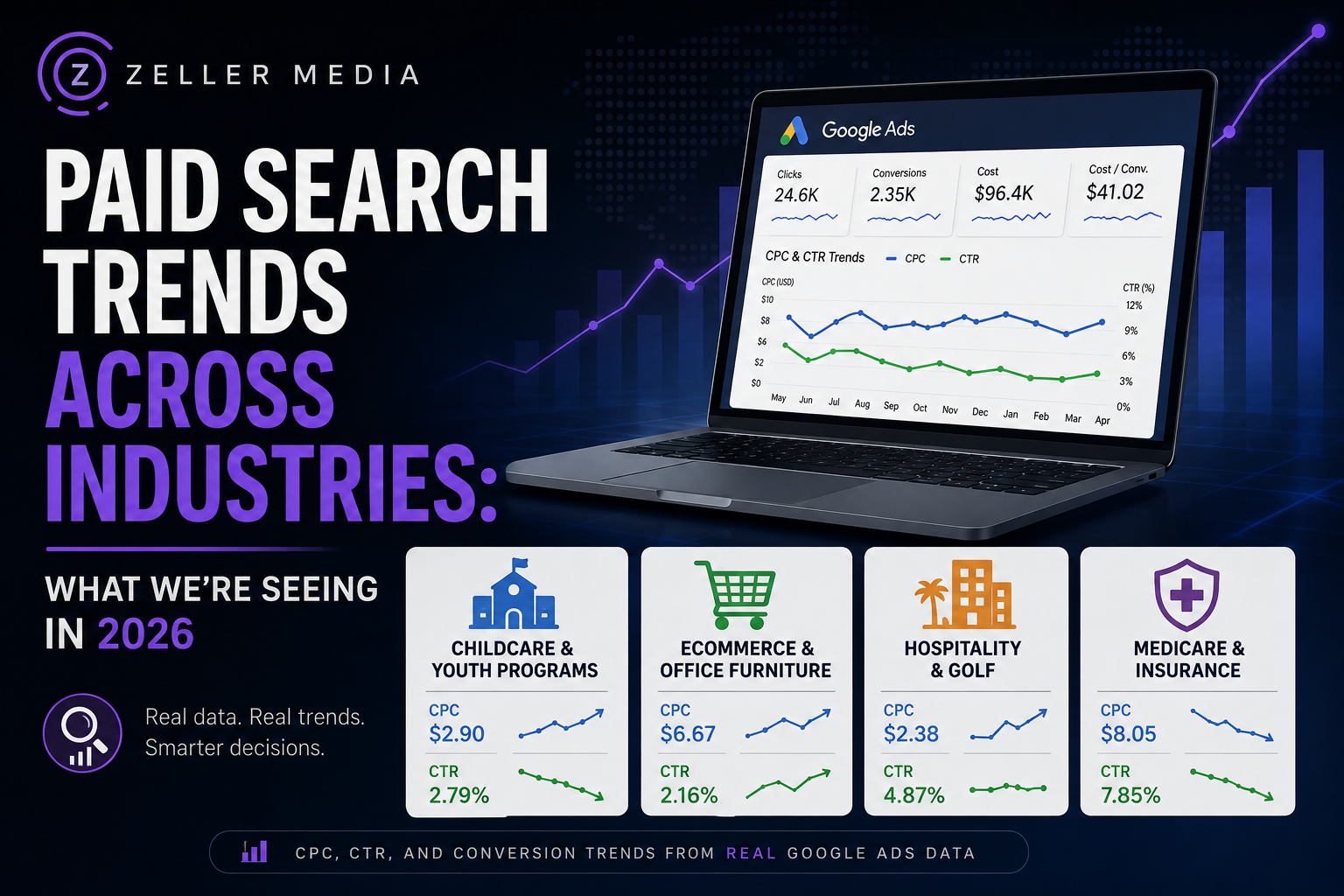
CPC: $2.90
CTR: 2.79%
The CPC changed very little, while CTR declined considerably.
That tells us something important: the cost of the click remained relatively consistent even as engagement with the available search traffic changed.
For these businesses, we don't want to stop at CPC or CTR.
The actual customer journey can look more like:
Search → Website → Lead → Tour → Enrollment
A campaign can therefore have acceptable paid search metrics while still needing improvement in lead quality, tour volume, or enrollment rate.
Hospitality & Golf
.png)
Hospitality and golf operate in a very different search environment.
Travel behavior, seasonality, events, holidays, and destination demand can all influence search volume and competition.
At the beginning of the mature period:
CPC: $1.99
CTR: 4.87%
By the end:
CPC: $2.38
CTR: 4.87%
The most interesting trend is that CPC increased by roughly 20%, while CTR remained essentially unchanged.
In other words, the cost of capturing the click increased, but the percentage of people clicking the ads remained remarkably consistent.
That isn't necessarily a negative.
For a resort or golf business, the value of a customer can justify a significantly higher CPC than a lower value business could tolerate.
That's why we look at the relationship between CPC, CTR, conversion rate, booking behavior, and revenue rather than trying to minimize click costs at all costs.
Medicare & Insurance
.png)
The economics are different because the value of a qualified customer can be significantly higher than the initial lead acquisition cost.
At the beginning of the mature period:
CPC: $8.74
CTR: 10.57%
By the end:
CPC: $8.05
CTR: 7.85%
Here, CPC actually decreased by roughly 8%, while CTR also declined.
This is a great example of why lower CPC does not automatically mean better performance.
We are paying less for each click, but fewer impressions are turning into clicks.
More importantly, neither metric tells us whether the leads are becoming customers.
For Medicare, the deeper funnel matters enormously:
Click → Lead → Qualified Lead → Application → Customer
That's why CRM integration and offline conversion tracking can be so valuable for this type of advertiser.
Ecommerce & Office Furniture
.png)
Ecommerce and office furniture have a very different paid search dynamic.
There can be substantial search volume, but that volume can consist of branded demand, product searches, category searches, Shopping traffic, returning customers, and genuine new customer acquisition.
At the beginning of the mature period:
CPC: $5.93
CTR: 1.91%
By the end:
CPC: $6.67
CTR: 2.16%
CPC increased by approximately 12%.
At the same time, CTR improved from 1.91% to 2.16%.
That combination is interesting.
Traffic became more expensive, but engagement improved.
This is why we don't automatically interpret a rising CPC as a negative trend.
If the additional cost is producing more qualified traffic and incremental revenue, the increase can be justified.
For ecommerce, we therefore look beyond CPC and CTR and consider:
- Conversion rate
- ROAS
- New customer acquisition
- Branded vs. non branded demand
- Revenue
- Customer value
A high ROAS can look attractive while the account remains overly dependent on existing demand.
Real Estate & Other High Value Services
For higher value service businesses, paid search economics can look very different from ecommerce or local consumer services.
The click itself can be relatively expensive, but the potential value of a qualified lead can be considerably higher.
In the real estate related data we analyzed, the mature period showed:
CPC: $7.10 → $7.00
CTR: 4.23% → 4.67%
CPC was essentially flat, while CTR improved.
That's a positive combination from an engagement perspective.
But even here, the paid search metrics don't tell the entire story.
A $7 click isn't necessarily expensive if it produces a qualified prospect who can generate substantial revenue.
Conversely, a cheaper click isn't necessarily valuable if it comes from someone with no genuine intent.
That's why search query quality and downstream lead quality are particularly important for high value services.
CPC Trends Across Industries
When we put the industries side by side, the difference becomes obvious.
At the beginning of the mature period, CPC ranged from approximately $2 to nearly $9, depending on the industry.
By the end, that range remained broadly similar.
That doesn't mean one industry has better paid search performance than another.
It reflects the economics and competitiveness of each market.
Medicare advertisers can rationally pay substantially more for a click than a childcare business if the resulting customer is worth significantly more.
The same principle applies to real estate, B2B, legal, healthcare, and other high value categories.
So rather than asking:
“Is my CPC too high?”
We prefer to ask:
“Is the value generated by these clicks high enough to justify what we're paying?”
CTR Trends Across Industries
CTR also varies dramatically by industry.
In the mature data, we saw industry level CTRs ranging from roughly 2% to more than 10%.
Again, there is no universal “good CTR.”
Medicare and insurance can naturally produce very different CTR behavior from ecommerce.
A highly specific search can also behave differently from a broad product search.
CTR is therefore best used as a diagnostic metric.
If CTR changes significantly, we want to understand why.
Did search behavior change?
Did competition change?
Did the ad messaging change?
Did keyword targeting broaden?
Are we attracting more or less relevant searches?
Those questions are more useful than simply celebrating a higher percentage.
Why We Focus on the More Mature Data
The first few months of an account can be noisy.
Campaign structures are changing.
Budgets are being adjusted.
Search queries are being cleaned up.
Tracking is being fixed.
Bidding strategies are being tested.
New campaigns are being launched.
Because of that, early performance doesn't necessarily represent the long term behavior of the account.
Once enough history accumulates, we can start identifying whether CPC and CTR are actually moving in a consistent direction.
That's why we put considerably more weight on the later portion of the dataset when analyzing these industry trends.
The Biggest Trend We See
After looking across childcare, hospitality, Medicare, ecommerce, real estate, and other businesses we work with, the biggest takeaway is simple:
There is no universal “good” CPC or CTR.
A $2 CPC can be expensive for one business.
A $9 CPC can be completely reasonable for another.
A 2% CTR can be healthy in one environment.
A 10% CTR can still produce poor quality traffic.
The metrics only become meaningful when they're connected to the economics of the business.
Paid Search Should Be Measured Against Business Growth
CPC tells us what we're paying for traffic.
CTR tells us how strongly our ads align with search intent.
Conversion rate tells us how efficiently that traffic turns into an action.
But none of those metrics, by themselves, tells us whether the business is growing.
For lead generation businesses, that means connecting advertising data to qualified leads, CRM outcomes, phone calls, and offline conversions.
For ecommerce, it can mean looking at new customers, revenue, repeat purchases, and profitability.
For hospitality, it can mean connecting campaigns to bookings and high value inquiries.
The definition of success changes with the business.
The Bottom Line
Paid search does not have one universal playbook.
The data across our client base shows just how different the economics can be from one industry to another.
CPC changes.
CTR changes.
Conversion rates change.
But the objective stays the same:
Turn paid search into sustainable business growth.
The best paid search strategy isn't necessarily the one with the lowest CPC or the highest CTR.
It's the one that understands the economics of the business, recognizes meaningful trends early, and turns those insights into better decisions.
Why Businesses Choose Zeller Media
If you’ve read this far, you can probably tell we have a strong opinion about what a paid search consultant and paid search agency should be.
That opinion comes from experience.
Bradley has spent more than 15 years managing paid search and paid social campaigns, including $100M+ in annual advertising budgets across ecommerce, healthcare, Medicare, finance, legal, hospitality, B2B, SaaS, and consumer brands. Before founding Zeller Media, he built and managed large-scale programs for major agencies and national advertisers, and he now applies that same performance discipline to mid-market businesses that need senior-level attention without enterprise bureaucracy.
Since launch, Zeller Media has worked with 35+ brands across DTC, B2B, and ecommerce, and our philosophy is simple: no layers, no junior handoffs, no bloated agency process. Clients work directly with the senior strategist managing the account.
That approach is reflected in our public reputation. Zeller Media currently holds 12 verified five-star reviews on Clutch, with clients consistently highlighting responsiveness, hands-on management, lead quality, and measurable business growth.
You can view the reviews here: Testimonials
Contact us and ask for an audit now: Contact Us