
A polished website, carefully produced commercial, and perfectly designed social post can communicate quality. But they can also create distance. The brand looks established, yet the customer may still struggle to see where they fit into the story.
That matters because most consumers are not looking for another company to admire. They are looking for a product, service, or experience that makes sense for their lives.
They want to see how it works, whether people like them trust it, and what they can realistically expect after buying.
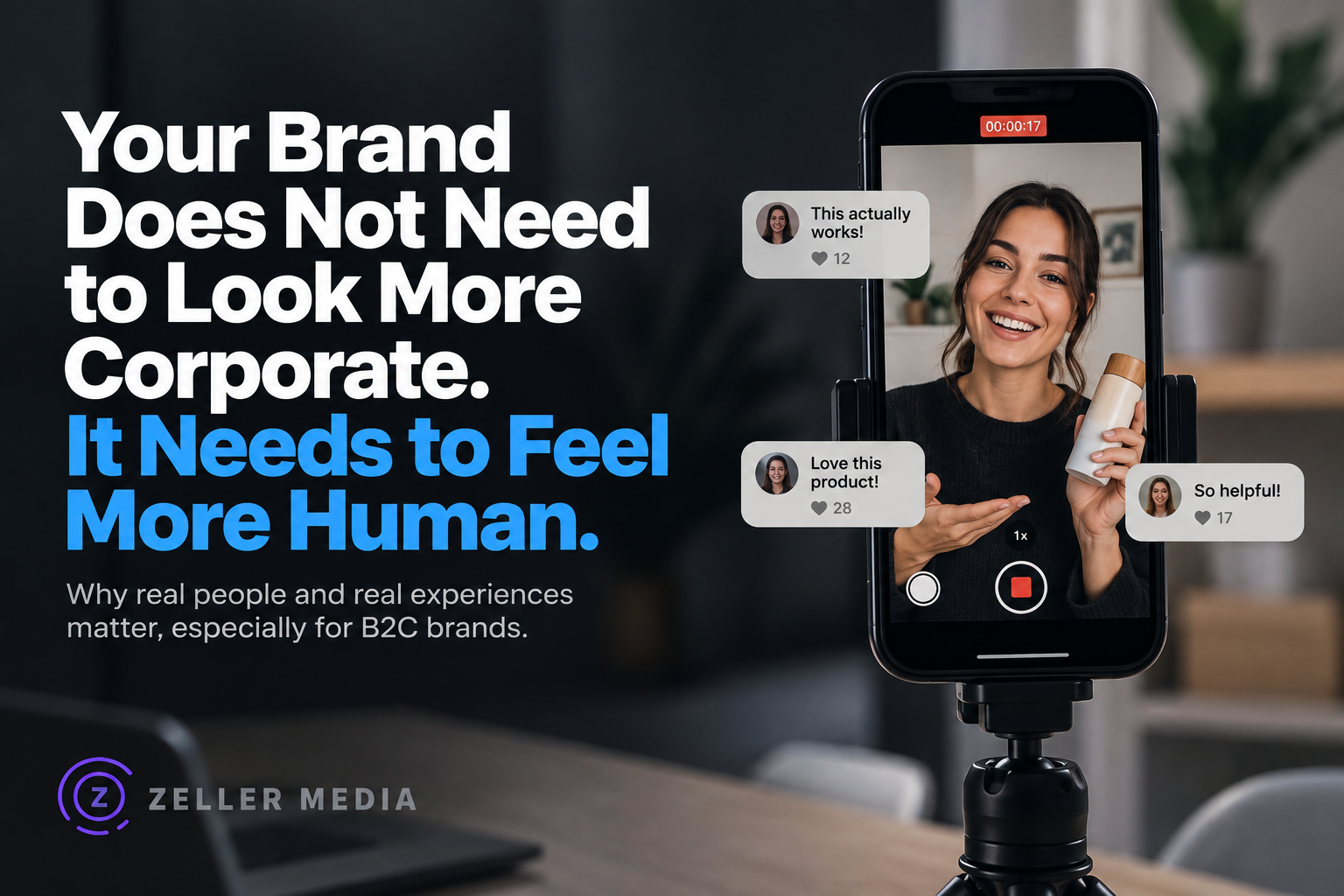
This is why user-generated content, or UGC, has become more important than another round of highly produced brand creative.
The value of UGC is not that it looks less professional.
The value is that it makes the brand feel more human.
The Problem With Overly Corporate Creative
Many brands communicate almost entirely from the company’s perspective.
The messaging focuses on:
- What the company offers
- How long it has been in business
- Its product features
- Its awards and credentials
- Its competitive advantages
- Its promotional offers
None of those things are inherently wrong. But when every piece of creative follows the same structure, the brand starts talking at the customer instead of connecting with them.
The customer is left asking:
“What does this actually mean for me?”
That question is particularly important in B2C.
A consumer may be choosing a childcare provider, purchasing a fitness product, booking a hotel, buying furniture, selecting a beauty product, or deciding whether to try a new service.
These decisions are rarely based on features alone. They involve trust, identity, lifestyle, emotion, and perceived risk.
A brand can explain what it does perfectly and still fail to make the customer feel understood.
People Often Trust Experiences More Than Claims
There is a major difference between a brand claiming that its product is useful and a customer showing how they use it.
A company can say:
“Our product makes everyday life easier.”
A customer can demonstrate what that actually looks like.
A brand can say:
“We provide a welcoming experience.”
A customer can show what made the experience feel welcoming.
A company can say:
“Our service helps families.”
A parent can explain how that service fits into their family’s routine.
The second version gives the audience context.
It turns an abstract claim into something visible and believable.
That is one of the strongest advantages of UGC. It allows potential customers to see the product through the experience of another person rather than only through the language of the company selling it.
UGC Helps Customers Picture Themselves Using the Product
The most effective UGC does more than feature a person speaking to a camera. It helps the audience imagine a future version of their own life.
That could mean:
- Seeing how a product fits into a daily routine
- Watching someone solve a problem the viewer is currently experiencing
- Understanding what the first few days with a product look like
- Seeing how a service works in a real environment
- Hearing a customer explain why they chose one option over another
- Watching someone demonstrate a product without overly scripted language
This is especially useful for products and services that are difficult to understand through traditional advertising.
A product page may explain the specifications. A UGC video can show the practical experience.
A brand may describe its atmosphere. A customer can show what it feels like to be there.
A company may list its benefits. A real person can explain why those benefits mattered.
The content becomes more than a sales message. It becomes a reference point.
Humanizing a Brand Does Not Mean Making It Look Amateur
There is a common misunderstanding about UGC.
Some brands assume that authentic content must look completely unproduced. Others create highly scripted videos that imitate the appearance of casual content but still feel like advertisements.
Neither approach is necessarily effective.
Authenticity is not the same as poor production quality.
A strong UGC asset can still have:
- Clear audio
- Good lighting
- A strong opening
- A focused message
- A natural delivery
- A relevant setting
- A clear connection to the product
- A defined objective
The difference is that the content does not feel like a company trying to sound like a company.
It feels like a person sharing something useful, relevant, or meaningful.
The best UGC is strategically structured without appearing overly controlled.
That balance is difficult to achieve, but it is where much of the value comes from.
UGC Is More Than a Testimonial
Testimonials are one form of UGC, but they are not the entire category.
A brand can use customer-generated content to create:
Product demonstrations
Show how the product works in a real environment.
Problem-solution stories
Start with a recognizable problem and show how the product helped solve it.
First impressions
Capture the initial reaction to a product, service, or experience.
Everyday routines
Show how the product fits naturally into the customer’s life.
Frequently asked questions
Use real people to answer questions that often prevent customers from buying.
Comparisons
Explain why someone chose the product over another option.
Behind-the-scenes experiences
Show what customers normally do not see before, during, or after the purchase.
Educational content
Use a customer or creator to explain something in a way that feels more accessible than a traditional brand message.
This variety matters because repeating the same testimonial format can become just as predictable as repeating the same polished advertisement.
The goal is not simply to add more people to the creative.
The goal is to introduce more relevant ways for customers to understand the brand.
UGC Can Strengthen Paid Media
Humanizing a brand is not only an organic social media strategy.
It can also improve the way a brand approaches paid media.
A paid ad has a limited amount of time to earn attention. If the creative immediately feels like another corporate advertisement, the audience may scroll past before understanding the message.
UGC can create a different entry point.
Instead of opening with a company statement, the ad might begin with:
- A customer describing a problem
- A relatable moment
- A surprising result
- A common misconception
- A personal recommendation
- A demonstration of the product in use
This can make the creative feel more native to the platform while giving the audience a reason to continue watching.
But the objective should not be to make every ad look like a social post.
The objective is to use the right creative format for the audience, message, and stage of the customer journey.
UGC may be particularly useful when the brand needs to build familiarity, explain an experience, overcome hesitation, or show the product in context.
Professional creative may be more appropriate when the brand needs to communicate premium positioning, product design, scale, or a major campaign concept.
The strongest paid media strategies do not force every message into one creative format.
A Human Brand Still Needs a Clear Positioning
There is another risk in the rush toward UGC: allowing the brand to become inconsistent.
If every creator uses a different tone, makes different claims, and presents the product in a completely different way, the brand can lose its identity.
Humanizing the brand should not mean abandoning brand strategy.
The company still needs to define:
- What it stands for
- Who it serves
- What makes it different
- What it wants to be known for
- What claims it can support
- What type of customer experience it wants to communicate
UGC should bring those ideas to life, not contradict them.
A premium brand can use UGC without looking careless.
A professional service can use UGC without losing credibility.
A well-established company can use real customer stories without appearing less sophisticated.
The format can feel personal while the underlying positioning remains consistent.
The Best UGC Makes the Brand Easier to Believe
Consumers have become highly familiar with advertising.
They recognize exaggerated claims, overly polished testimonials, artificial enthusiasm, and scripts that sound like marketing copy.
That does not mean customers reject all advertising. It means brands need to communicate in ways that feel more relevant and credible.
UGC can help because it introduces a different kind of evidence.
It shows the product being used.
It gives the customer a voice.
It provides context that a traditional advertisement may not include.
It makes the brand feel less distant.
For B2C businesses, that can have a meaningful impact on how customers perceive the company before they ever make a purchase.
And in categories where trust plays a major role, perception is not a secondary concern. It is part of the buying decision.
The Real Opportunity Is Not “More UGC”
The real opportunity is to stop treating every customer interaction as a corporate announcement.
Brands should ask:
“How can we communicate this message in a way that feels more natural, relatable, and useful to the person receiving it?”
Sometimes the answer will be UGC.
Sometimes it will be a professional product video, a founder-led explanation, a customer interview, a demonstration, or a simple piece of educational content.
The important part is not the format itself.
It is whether the creative helps the customer understand the product and trust the brand.
For B2C companies, the brands that stand out will not necessarily be the ones with the most polished advertising.
They will be the ones that make customers feel understood.
Your brand does not need to look more corporate.
It needs to feel more human.
Why Businesses Choose Zeller Media
If you’ve read this far, you can probably tell we have a strong opinion about what a paid search consultant and paid search agency should be.
That opinion comes from experience.
Bradley has spent more than 15 years managing paid search and paid social campaigns, including $100M+ in annual advertising budgets across ecommerce, healthcare, Medicare, finance, legal, hospitality, B2B, SaaS, and consumer brands. Before founding Zeller Media, he built and managed large-scale programs for major agencies and national advertisers, and he now applies that same performance discipline to mid-market businesses that need senior-level attention without enterprise bureaucracy.
Since launch, Zeller Media has worked with 35+ brands across DTC, B2B, and ecommerce, and our philosophy is simple: no layers, no junior handoffs, no bloated agency process. Clients work directly with the senior strategist managing the account.
That approach is reflected in our public reputation. Zeller Media currently holds 12 verified five-star reviews on Clutch, with clients consistently highlighting responsiveness, hands-on management, lead quality, and measurable business growth.
You can view the reviews here: Clutch Testimonials
Contact us and ask for an audit now: Contact Us


