The Difference Between Capturing Demand and Buying Growth
The Problem
A paid search account can look incredibly successful while contributing very little incremental growth.
You can have:
High ROAS.
Low CPA.
Lots of conversions.
Strong conversion rates.
And still be mostly capturing demand that already existed.
The clearest example is branded search.
Someone searches for your company by name, clicks your ad, and converts.
Google Ads reports a conversion.
The campaign looks successful.
And technically, it was.
But did the advertising create that customer?
Or did the customer already know who you were and simply use Google to find you?
That distinction matters enormously when you're evaluating whether paid media is actually growing the business.
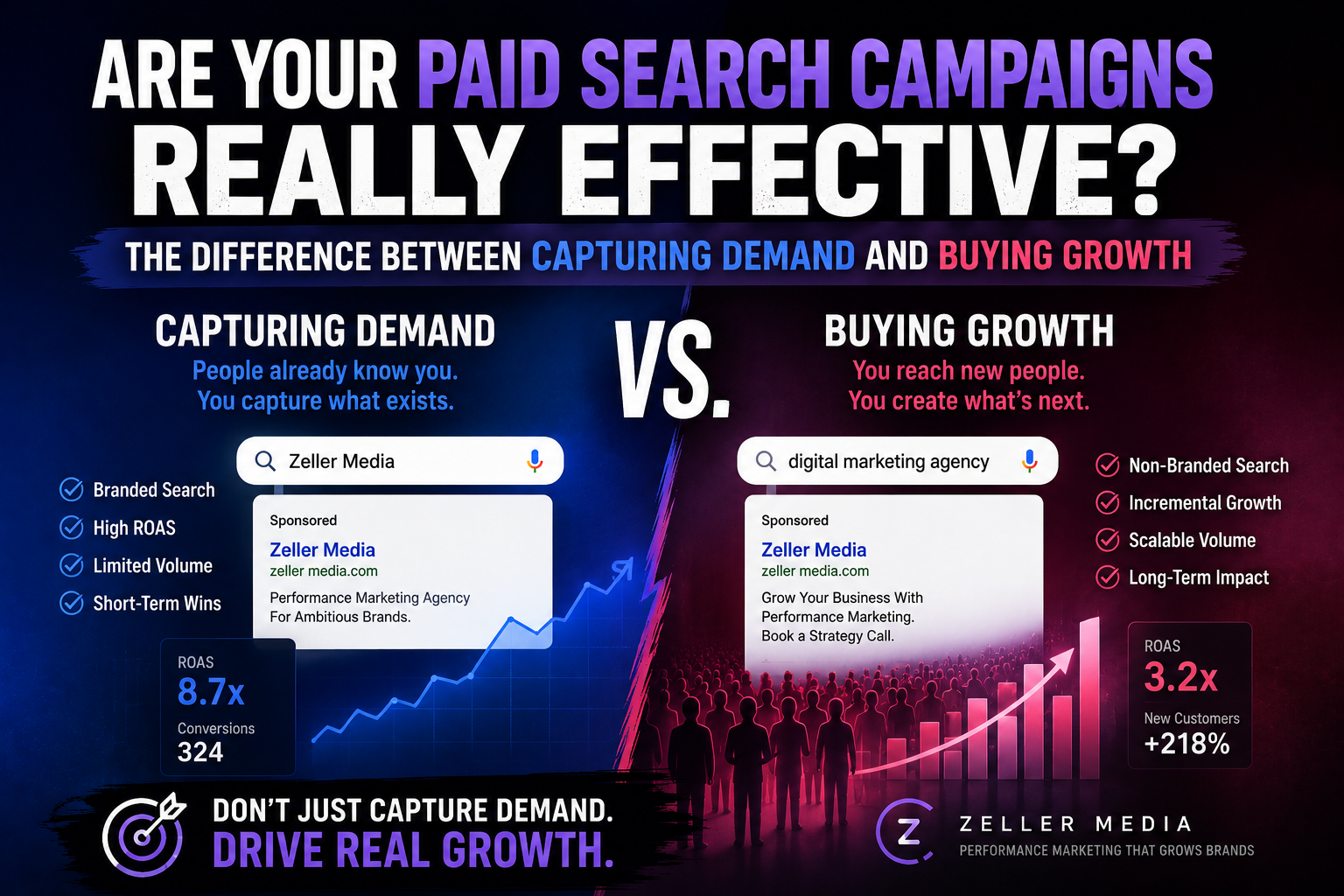
Capturing Demand vs. Buying Growth
There are two very different jobs paid media can perform.
Capturing demand
Branded search is the obvious example.
Someone searches:
“Zeller Media”
“Nike shoes”
“Medicare Advantage [Brand Name]”
They already have some level of awareness.
Your ad helps you capture the search.
That's valuable.
But it doesn't necessarily mean you created the demand.
Buying Growth
Buying growth is different.
You're using advertising to reach people who aren't already searching specifically for your brand and giving them a reason to become customers.
This is where non branded search, paid social, CTV, prospecting, creative testing, and other acquisition channels become much more important.
The objective isn't simply:
“How many conversions did our ads generate?”
It's:
“How much additional demand did our marketing create or capture that wouldn't have happened otherwise?”
Don't Take Too Much Credit for Branded Search
This is one of the easiest ways for a paid media program to make itself look better than it actually is.
Imagine a company spends $20,000 on Google Ads.
The account generates $100,000 in attributed revenue.
That's a 5x ROAS.
Sounds great.
The account may be extremely efficient at capturing demand, while doing relatively little to expand the company's customer base.
This is why we don't believe branded search should be treated as the ultimate proof that paid search is driving growth.
Branded campaigns can be extremely valuable.
They can protect valuable searches.
They can help control the search results page.
They can capture high intent.
They can defend against competitors.
They can provide efficient conversions.
But they have a natural limitation:
There is only so much branded demand available to capture.
You can't infinitely scale a campaign based on the number of people already searching for your company.
If branded search is responsible for a large portion of your paid search success, your growth ceiling may be much lower than your ROAS suggests.
Branded Search Should Be the Bare Minimum
This doesn't mean businesses shouldn't run branded campaigns.
Quite the opposite.
For a business with meaningful search volume and an appropriate budget, having branded search covered should generally be considered the baseline, not the entire strategy.
The bigger question is:
What are we doing beyond the people who already know us?
That's where non branded search becomes important.
Instead of only targeting:
“ABC Insurance”
you might test searches around:
“Medicare insurance plans”
“Medicare supplement plans”
“Medicare agent near me”
Now you're competing for people who have demonstrated relevant intent but haven't necessarily chosen your company yet.
That's a fundamentally different growth opportunity.
Your Paid Search Strategy Should Have a Non Branded Growth Engine
A healthy paid search strategy should continuously ask:
What happens if we increase our non branded investment?
Not every business will have enough search volume to make non branded search a massive channel.
Some industries have extremely limited demand.
Some keywords are too expensive.
Some searches don't indicate meaningful purchase intent.
And sometimes paid search simply isn't the best channel for creating new demand.
That's okay.
The point isn't to force non branded search into every account.
The point is to test whether it can create incremental growth instead of assuming branded search is enough.
That's the difference between managing an account and managing growth.
The Test Is More Important Than the ROAS
Suppose your branded campaign produces a 15x ROAS.
Your non branded campaign produces a 3x ROAS.
It's tempting to say:
“Branded is clearly the better campaign.”
But that's not necessarily the right conclusion.
The branded campaign may have almost unlimited efficiency but limited incremental volume.
The non branded campaign may have lower efficiency but provide access to a much larger pool of potential customers.
You need to ask:
Which campaign has more room to grow?
That's a much better question than:
Which campaign has the highest ROAS?
This Is Where Incrementality Matters
The ultimate question isn't simply whether a conversion happened after an ad click.
It's whether the advertising changed the outcome.
If someone was already searching for your brand, there is a reasonable possibility that they would have found you and converted anyway.
If someone searched for a generic service, discovered your company through an ad, became a lead, and eventually became a customer, the advertising may have played a much more meaningful role in creating that outcome.
That's why serious paid media programs need to look beyond platform attributed conversions.
You may need:
CRM data.
Offline conversions.
Qualified lead data.
Customer acquisition cost.
Lifetime value.
New customer rates.
Geographic testing.
Incrementality testing.
And cross channel analysis.
The more you connect advertising data to actual business outcomes, the easier it becomes to distinguish demand capture from genuine growth.
The Same Principle Applies Beyond Google Ads
This isn't exclusively a search problem.
Meta can capture existing demand through retargeting.
Google can capture branded demand.
Email can capture people already familiar with your company.
Remarketing can convert people who already visited your website.
All of these can be valuable.
But if the majority of your marketing budget is spent harvesting people who already know you, eventually you run into the same problem.
You become very good at converting the audience you already have without necessarily expanding it.
That's why prospecting and demand generation matter.
Paid social can introduce your brand to new audiences.
CTV can build awareness.
Non branded search can capture category level intent.
Creative can introduce new problems and solutions.
And the combination of these channels can create demand that eventually appears somewhere else in your attribution reports.
What We Actually Want to See in a Paid Search Account
We don't want every campaign to have the same job.
A healthy account can have campaigns designed to:
Protect existing demand
Branded search.
Capture high intent
Non branded search.
Expand into new opportunities
New keyword themes, categories, locations, services, and audiences.
Test incremental demand
New markets and non branded acquisition strategies.
The important thing is knowing which job each campaign is performing.
Otherwise, you can end up celebrating a great blended ROAS without realizing that most of your budget is simply harvesting demand that already existed.
The Bottom Line
Paid media can do two very different things.
It can capture demand that already exists.
Or it can help create and acquire new demand that expands the business.
Both are valuable.
But they shouldn't be confused.
Branded search is often the easiest place to find efficient conversions, and businesses with meaningful branded demand should generally have it covered.
But branded search should be the floor, not the ceiling.
The real growth opportunity comes from testing what happens beyond the people who already know your name.
Because a 10x ROAS campaign that can't meaningfully scale may be less valuable to your business than a 3x ROAS campaign that can continuously bring in new customers.
The goal isn't to make your ad account look efficient.
The goal is to make the business bigger.
Why Businesses Choose Zeller Media
If you’ve read this far, you can probably tell we have a strong opinion about what a paid search consultant and paid search agency should be.
That opinion comes from experience.
Bradley has spent more than 15 years managing paid search and paid social campaigns, including $100M+ in annual advertising budgets across ecommerce, healthcare, Medicare, finance, legal, hospitality, B2B, SaaS, and consumer brands. Before founding Zeller Media, he built and managed large-scale programs for major agencies and national advertisers, and he now applies that same performance discipline to mid-market businesses that need senior-level attention without enterprise bureaucracy.
Since launch, Zeller Media has worked with 35+ brands across DTC, B2B, and ecommerce, and our philosophy is simple: no layers, no junior handoffs, no bloated agency process. Clients work directly with the senior strategist managing the account.
That approach is reflected in our public reputation. Zeller Media currently holds 12 verified five-star reviews on Clutch, with clients consistently highlighting responsiveness, hands-on management, lead quality, and measurable business growth.
You can view the reviews here: Testimonials
Contact us and ask for an audit now: Contact Us