
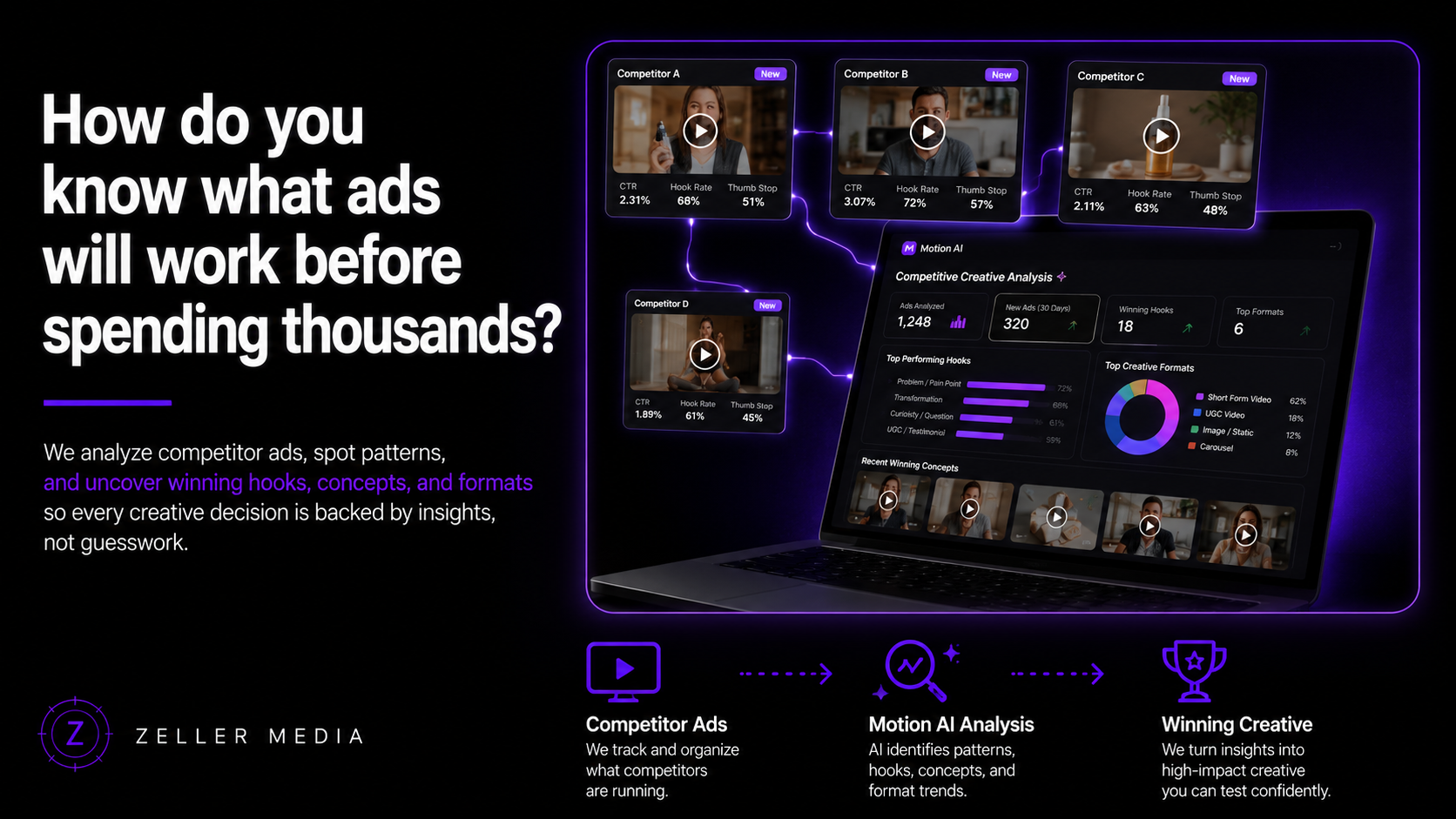
How Do You Know What Will Work Before Spending Thousands?
One of the questions we hear most from new clients is surprisingly simple:
"How do you know which ads we should create next?"
The truth is... We don't predict the future.
But we do everything possible to reduce guesswork before launching a campaign.
Every month, we study what competitors are doing, compare those insights against our own campaigns, and use that research to build our next round of creative tests.
That process has become one of the most valuable parts of our creative strategy.
Every Competitor Leaves Clues
Most major advertising platforms already provide public ad libraries:
These libraries allow anyone to see active advertisements from other businesses.
That alone is valuable, but reviewing dozens, or even hundreds of ads manually, becomes overwhelming very quickly.
Instead of trying to remember what every competitor is doing, we organize that research into a structured monthly workflow.
We Track Competitors All Year Long
For every client we manage, we build a shortlist of the competitors that matter most.
Those competitors remain on our watchlist throughout the year.
Every month, we review questions like:
- What new ads were launched?
- Which creative concepts keep appearing?
- What hooks are being repeated?
- Which offers are becoming more common?
- Are competitors testing new formats?
- Are they leaning more into UGC, static images, or video?
- Which service categories are receiving the most attention?
We're not trying to copy their ads.
We're trying to understand where the market is moving.
Patterns Matter More Than Individual Ads
One advertisement rarely tells you anything meaningful, patterns do.
If five competitors begin leading with the same type of hook, that's worth investigating, if multiple brands suddenly shift toward short-form videos, that's a signal.
If everyone begins promoting one service more aggressively than another, we want to understand why.
Creative strategy becomes much more reliable when it's based on recurring market behavior instead of isolated examples.
We Use Motion to Organize the Research
This is where Motion becomes an important part of our process.
Rather than jumping between multiple ad libraries, Motion allows us to organize competitor activity in one place.
We can quickly review:
- Recently launched creatives
- Active advertisements
- Creative formats
- Messaging themes
- Hooks
- Service categories
- Creative timelines
Instead of spending hours collecting screenshots, we spend that time analyzing what actually matters.
Then We Let AI Do the Heavy Lifting
Once our competitor research is organized, we use Motion's AI to help summarize everything we've observed.
Rather than manually reviewing every creative one by one, AI helps us identify recurring themes across the entire competitive landscape.
It highlights:
- Common hooks
- Frequently used creative concepts
- Emerging messaging trends
- Creative formats that appear to be gaining momentum
- Differences between each competitor's approach
That gives us a much faster understanding of what's happening across the market before we begin our own analysis.
Then We Compare Everything Against Our Own Campaigns
This is where the process becomes much more valuable.
Looking at competitors alone only tells part of the story.
Next, we compare those market insights against our own creative performance.
We look for opportunities such as:
- Creative angles competitors are exploring that we haven't tested yet.
- Service categories receiving little attention from our own campaigns.
- Formats that are becoming increasingly common across the industry.
- Messaging trends that align with our clients' positioning.
The goal isn't to imitate competitors.
It's to identify opportunities we might otherwise overlook.
Research Comes Before Creativity
Many people assume great advertising starts with brainstorming.
For us, brainstorming comes later, research comes first.
Once we understand what's happening across the market and how our own campaigns compare, we begin developing entirely new creative concepts inspired by those insights.
Every recommendation is grounded in data, competitive research, and real market activity instead of assumptions.
Final Thoughts
Creative strategy shouldn't begin with a blank page.
It should begin with understanding the market.
By combining competitor research, organized creative tracking, AI-assisted analysis, and our own campaign performance, we're able to make smarter creative decisions before investing thousands of dollars into production and media spend.
We still test, we still experiment.
But every test starts with a much stronger hypothesis.
Because better advertising isn't about guessing what might work.
It's about learning from the market, identifying opportunities, and turning those insights into better creative ideas.


