.png)
Why Your Google Ads Leads Are Getting Worse (And What High-Performing Advertisers Do Differently)
Your Google Ads dashboard says performance is improving:
- Lead volume is up.
- Cost per lead is down.
- Conversion rates look healthy.
So why is your sales team telling a completely different story?
If your business is generating more leads but fewer qualified opportunities, you're not alone. It's one of the most common challenges we're seeing across Google Ads and Microsoft Ads accounts today.
Many businesses assume declining lead quality is caused by rising competition, broader targeting, or changes in Google's algorithms. While those factors can contribute, they're rarely the primary issue.
More often, the problem comes down to something much simpler:
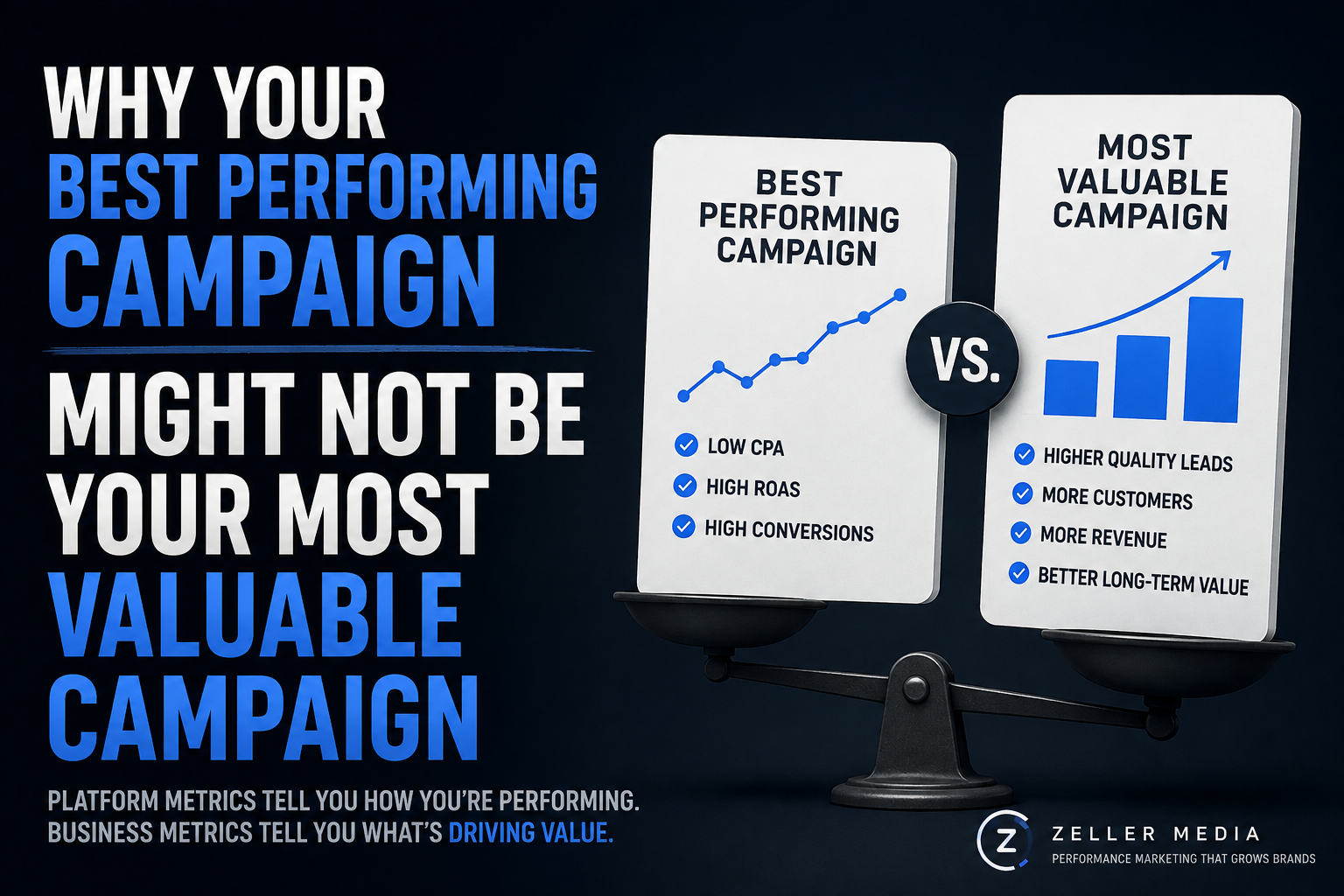
Your advertising platforms are optimizing for conversions, not necessarily for customers.
As automation becomes increasingly central to digital advertising, the quality of the data you provide to ad platforms has become one of the biggest factors determining campaign success.
Why More Leads Doesn't Always Mean Better Performance
Modern advertising platforms are incredibly effective at generating conversions.
Using machine learning, Google Ads and Microsoft Ads analyze thousands of signals to identify users most likely to complete a desired action. The more conversion data they receive, the more aggressively they optimize toward that outcome.
The challenge is that not all conversions have the same business value.
Consider the following example:
- A decision-maker from your ideal target company requests a consultation.
- A student conducting research submits the same form.
- A competitor fills out your contact form.
- A consumer looking for a service you don't provide calls your business.
-
From an advertising platform's perspective, all four actions may be recorded as conversions.
From a business perspective, only one of them may represent a genuine sales opportunity.
When every lead is treated equally, advertising platforms learn from every lead equally.
Over time, this creates a disconnect between marketing performance and business performance.
The Automation Trap
Automation isn't the problem.
Poor signals are.
Google Ads and Microsoft Ads are designed to find more people who resemble previous converters.
If your campaigns optimize toward form submissions, the platforms will find more users likely to submit forms.
If your campaigns optimize toward phone calls, they'll find more users likely to call.
The algorithms aren't making mistakes.
They're simply pursuing the goals they've been given.
This is why many advertisers experience a frustrating pattern:
- Lead volume increases
- Conversion rates improve
- Cost per lead decreases
- Sales quality declines
The campaigns appear to be performing better.
The business experiences the opposite.
Why Lead Quality Often Declines Over Time
Many campaigns launch with highly controlled targeting.
Advertisers focus on:
- Exact-match keywords
- Highly relevant search queries
- Carefully selected audiences
- Conservative bidding strategies
As campaigns mature, automation expands.
Advertisers adopt:
- Smart Bidding
- Broad Match
- Performance-based optimization
- Audience expansion
These tools can be incredibly effective when they're supported by strong conversion data.
The problem is that many businesses are still optimizing toward surface-level metrics such as form fills and phone calls.
As a result, the platforms naturally discover easier ways to generate conversions.
Not necessarily better conversions.
Just easier ones.
This often explains why businesses see improving advertising metrics while simultaneously experiencing declining lead quality.
In some cases, advertisers assume the issue is budget-related when the real problem is optimization and measurement. If you're unsure whether your budget is helping or hurting performance, our guide on how much to spend on Google Ads breaks down the factors that influence campaign growth and efficiency.
The Missing Piece: Offline Conversion Tracking
One of the biggest differences between average advertisers and high-performing advertisers is what happens after a lead enters the CRM.
Most advertisers track:
- Form submissions
- Phone calls
- Landing page conversions
Far fewer track what happens later in the sales process.
This is where offline conversion tracking becomes critical.
Offline conversion tracking allows businesses to send meaningful sales data back to advertising platforms.
Instead of optimizing toward every lead, campaigns can begin optimizing toward:
- Marketing Qualified Leads (MQLs)
- Sales Qualified Leads (SQLs)
- Opportunities
- Closed deals
- Revenue
This creates a much stronger feedback loop.
Rather than learning from anyone who completes a form, the platform begins learning from people who actually become customers.
According to Google's guidance on offline conversion imports, feeding CRM and sales data back into Google Ads helps advertisers optimize campaigns based on real business outcomes rather than basic lead-generation metrics.
Similarly, Google's documentation on Smart Bidding emphasizes the importance of high-quality conversion signals when using automated bidding strategies.
What High-Performing Advertisers Do Differently
Most advertisers focus on generating more leads.
The best advertisers focus on generating better signals.
At Zeller Media, we've found that lead quality improvements often come from improving measurement, not simply adjusting campaigns.
The highest-performing accounts typically have several things in common.
They Connect Advertising Platforms to CRM Data
Campaigns are evaluated based on sales outcomes rather than marketing metrics alone.
This allows bidding algorithms to prioritize leads that actually contribute to revenue.
They Align Marketing and Sales
Lead qualification criteria are clearly defined.
Marketing and sales teams agree on what constitutes a qualified opportunity, reducing the gap between reported performance and actual business results.
They Use Revenue as a Success Metric
Clicks, conversions, and cost per lead all matter.
But ultimately, revenue matters more.
The most successful advertisers measure performance based on business outcomes rather than platform metrics.
They Continuously Refine Audience Signals
As platforms receive more qualified conversion data, audience targeting improves.
Campaigns become more efficient because machine learning has access to better information.
Businesses adapting to the growing influence of automation may also benefit from understanding how AI is changing digital advertising and what advertisers should do about it
Signs Your Campaigns May Have a Signal Quality Problem
You may be optimizing toward the wrong outcome if:
- Lead volume is increasing but sales are not.
- Cost per lead is improving while revenue remains flat.
- Sales teams frequently reject leads.
- Marketing reports strong performance but sales disagrees.
- Most optimization decisions are based on form submissions rather than qualified opportunities.
If these issues sound familiar, the problem may not be your targeting strategy.
It may be the quality of the data driving your optimization.
Why This Matters More Than Ever
As Google and Microsoft continue investing heavily in AI-powered automation, advertisers have less manual control than they did just a few years ago.
Success increasingly depends on providing platforms with accurate, meaningful business signals.
The companies that adapt to this reality gain a significant competitive advantage.
Those that continue optimizing toward basic lead-generation metrics often struggle with declining lead quality despite improving campaign performance.
For businesses evaluating whether they should manage campaigns internally or seek expert support, our article on whether you need a paid media consultant or can run Google Ads yourself outlines the key considerations.
Final Thoughts
If your Google Ads leads are getting worse, the solution may not be new keywords, new ads, or a different bidding strategy.
The real issue may be the data guiding your campaigns. Modern advertising platforms are remarkably effective at finding more of what they're asked to find.
The challenge is making sure they're optimizing toward outcomes that actually drive business growth. That's why the most successful advertisers focus on more than clicks, conversions, and lead volume.
They focus on signal quality, offline conversion tracking, CRM integration, and revenue attribution. Because in today's advertising landscape, better data creates better optimization.
And better optimization creates better customers.