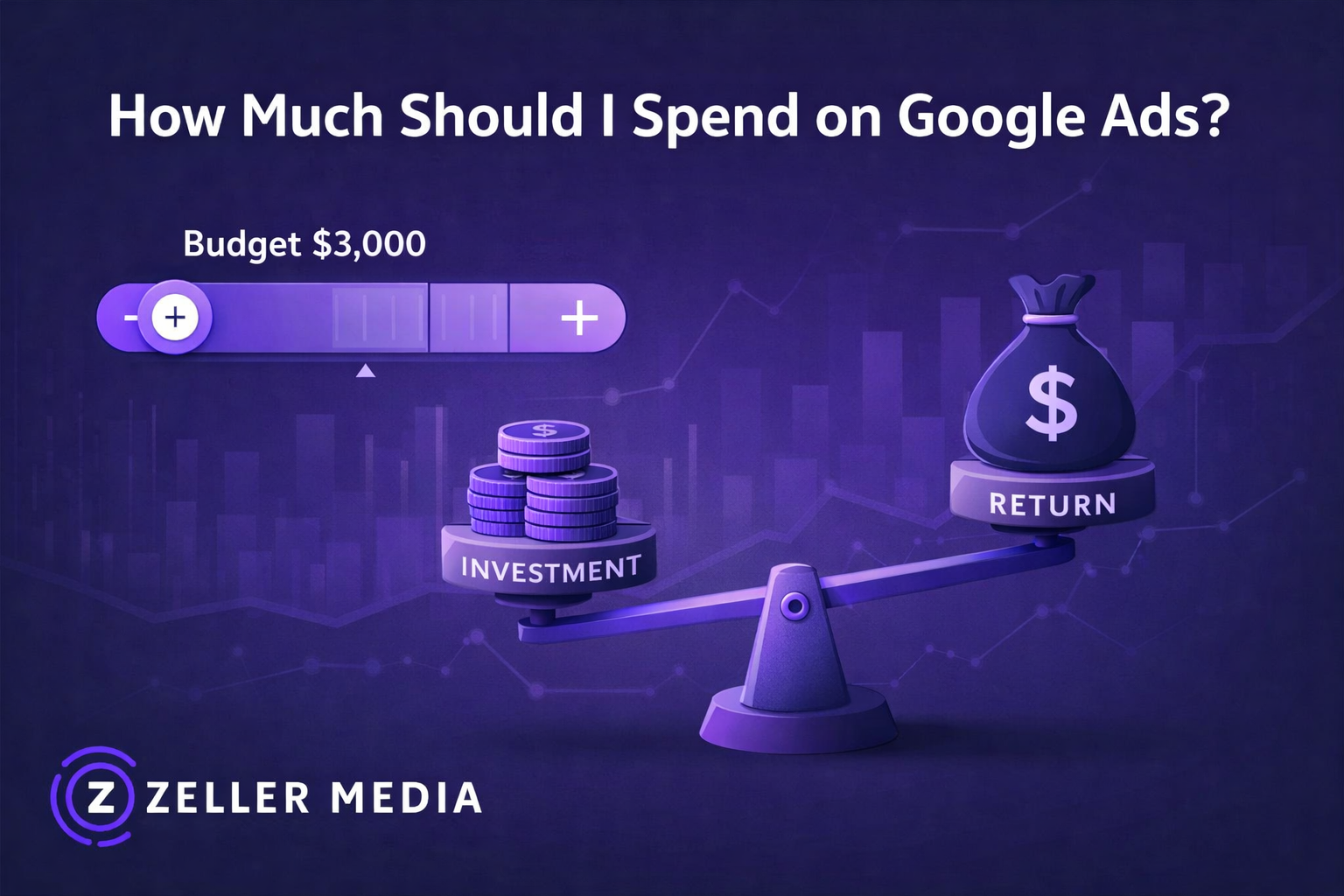
It’s the most common question I get from new prospects: how much should I be spending on Google Ads? The honest answer is that there’s no universal number. But there is a framework. And most of the advice floating around online — “start with $10 a day” or “budget 5-10% of revenue” — is either too generic to be useful or actively misleading. After working with 35+ brands across lead generation, ecommerce, financial services, healthcare, and more, here’s how I actually think about Google Ads budgets — and how you should too.
Why “It Depends” Is Not a Good Enough Answer
Yes, your ideal budget depends on your industry, your competition, your margins, and your goals. Every consultant says that. But it’s not helpful unless someone shows you how those variables interact. Here’s the formula that actually matters: your Google Ads budget is a function of three things — your average cost per click, your landing page conversion rate, and your target cost per acquisition. If your average CPC is $5, your landing page converts at 5%, and you need a cost per lead under $100, then you need 20 clicks to generate one lead at $100.
That’s your unit economics. Your budget is just that math multiplied by how many leads you want per month. If you want 50 leads per month at those numbers, you need $5,000 in monthly spend. If you want 200, you need $20,000. The budget doesn’t determine the strategy. The strategy determines the budget. If you don’t know your CPC, your conversion rate, and your target CPA, you’re not budgeting. You’re guessing.
Minimum Viable Budgets by Business Model
Here’s where I’ll give you real numbers, with the caveat that these are starting points based on what I’ve seen work across dozens of accounts — not guarantees. For local service businesses — lawyers, dentists, contractors, real estate agents — you can start testing with $2,000 to $5,000 per month. CPCs are often manageable, the geographic targeting is tight, and you can learn a lot about what works without a massive investment. But don’t expect to scale aggressively at this level.
You’re buying data, not dominating the market. For lead generation businesses in competitive verticals — financial services, Medicare, insurance, B2B SaaS — you typically need $5,000 to $20,000 per month minimum to generate enough volume for meaningful optimization. CPCs in these verticals often range from $10 to $50+, which means a small budget generates very few clicks, very few conversions, and not enough data for smart bidding to learn effectively. For ecommerce businesses running Shopping and Search campaigns, $3,000 to $15,000 per month is a reasonable starting range depending on your catalog size and margins.
Shopping campaigns can be highly efficient if your product feed is clean and your pricing is competitive. But if you’re in a crowded category, you’ll need more budget to maintain impression share and visibility. For startups testing product-market fit through paid acquisition, I recommend budgeting enough to reach statistical significance on your core metrics within 30 to 60 days. That usually means $3,000 to $10,000 for an initial test phase, with a clear plan to scale or cut based on what the data shows.
These ranges are not prescriptive. They’re informed by patterns across 35+ brands. Your situation may be different — which is exactly why an audit matters before committing budget.
The Mistakes That Waste Budget
Spending the right amount doesn’t help if you’re spending it wrong. Here are the most common budget-related mistakes I see when I audit accounts. Spreading budget too thin across too many campaigns. If you have $5,000 per month and you’re running 12 campaigns, most of them are starving. Algorithms need data to optimize. Underfunded campaigns never exit the learning phase, which means your bid strategies never stabilize, which means your costs stay high and your results stay inconsistent. Not accounting for learning phase requirements. Google’s smart bidding strategies need roughly 30 to 50 conversions per month per campaign to optimize effectively. If your budget only generates 8 conversions per month in a campaign, the algorithm is essentially flying blind. You’re paying for automation that can’t do its job.
Spending without tracking. This sounds basic, but I see it constantly. Businesses spending $10K+ per month on Google Ads without proper conversion tracking, without CRM integration, without knowing whether the leads they’re paying for are actually turning into revenue. That’s not a budget problem. That’s a measurement problem. Spending the same amount every month regardless of performance. Your budget should flex based on what the data tells you. If a campaign is printing money, give it more. If a campaign is bleeding, cut it or restructure it. Static budgets in a dynamic auction are a recipe for waste.
The goal is not to spend a specific amount. The goal is to spend efficiently at whatever level drives profitable outcomes.
How to Know If You’re Spending Enough
There are a few signals that tell you your budget is too low. Your campaigns are limited by budget every day. This means Google is shutting off your ads partway through the day because you’ve hit your daily cap. You’re missing potential conversions during hours when your audience is actively searching. Your impression share is below 50% on your most important keywords. If you’re only showing up for half the searches that match your targeting, you’re leaving opportunity for competitors to capture.
You don’t have enough conversions for smart bidding to optimize. If your campaigns are stuck in learning phase month after month, the budget is too low relative to your CPC and conversion rate. You can’t afford to test. If every dollar is accounted for and there’s no room to try new keywords, new ad copy, new landing pages, or new audiences, you’re operating in survival mode. Growth requires experimentation, and experimentation requires budget headroom.
How to Know If You’re Spending Too Much
Conversely, here are signs your budget is too high — or at least misallocated. Your cost per acquisition is climbing but your conversion volume isn’t. This usually means you’ve saturated your most efficient audience and the algorithm is pushing into lower-quality traffic to spend the remaining budget. Your search query reports show significant irrelevant traffic. If 20-30% of your clicks come from searches that have no commercial intent, you’re not overspending — you’re mis-spending. The fix isn’t reducing budget. It’s tightening targeting and adding negative keywords. You’re spending heavily on Performance Max without understanding where the budget goes. PMax distributes spend across Search, Shopping, Display, YouTube, Gmail, and Discover. If you can’t see the breakdown and you don’t know what percentage is going to low-quality Display placements, your budget might be larger than it needs to be.
The Real Framework
Here’s how I approach budget planning with every Zeller Media client. Start with the business goal: how many customers, leads, or sales do you need per month? Work backward from your target CPA or ROAS to determine how much spend that requires. Validate the math against your actual CPC and conversion rate data — or, if you’re starting fresh, against industry benchmarks with the understanding that benchmarks are estimates, not promises. Set an initial budget that generates enough conversion volume for the algorithm to learn.
Run for 30 to 60 days. Analyze performance. Then make a data-driven decision about whether to scale, hold, or reallocate. The budget is not the strategy. The strategy is the system — paid search, paid social, tracking, landing pages, creative, and reporting all working together. The budget is what fuels that system. If the system is broken, more fuel just burns faster.
Here is a free tool we created to help you plan your budget.
If you’re not sure whether your current budget is right — or whether it’s being spent efficiently — book an audit. I’ll show you exactly where your money is going and whether it’s working. Don’t ask how much to spend. Ask how much you can spend profitably. Then build the system to support it.