We Thought Google AI Max Was Trash. Until We Found This.
Whenever Google introduces a new AI feature, the PPC community usually reacts in one of two ways.
Some advertisers enable it immediately, hoping Google's machine learning will outperform manual optimization.
Others dismiss it before giving it a fair chance.
We tend to take a different approach.
Every new Google Ads feature goes through the same process. We test it on real accounts, monitor performance closely, and validate results using actual business data, not just what Google Ads reports.
That's exactly how we approached AI Max.
And honestly, our first impression wasn't great.
The First Week Looked Too Good to Be True

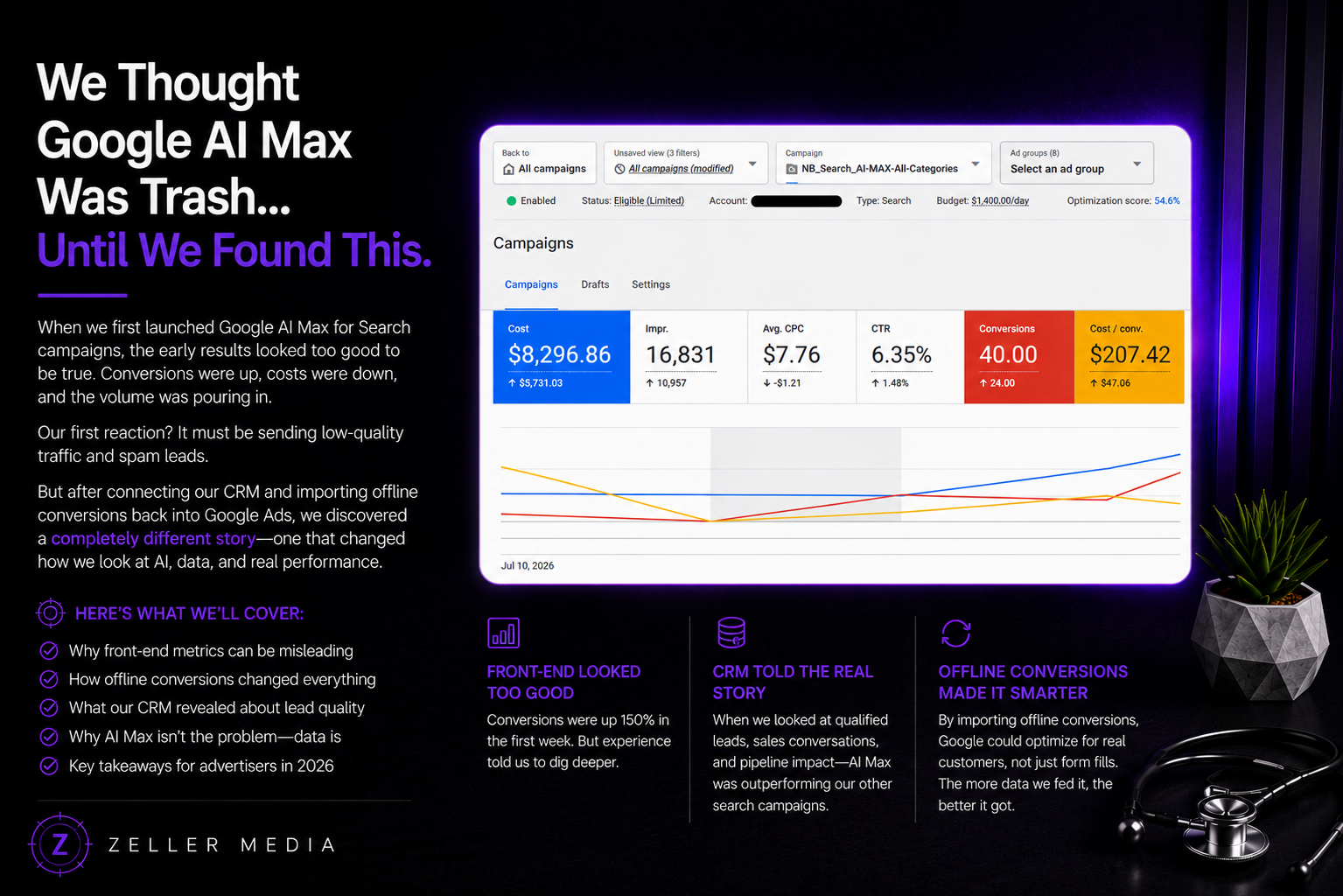
Within days of launching AI Max, the campaign began generating significantly more conversions than our traditional Search campaigns.
Impressions increased.
Click through rate improved.
Conversions climbed quickly.
At first glance, it looked like an incredible success.
Ironically, that's exactly what made us suspicious.
After managing Google Ads for years, we've learned that unusually high conversion numbers don't always translate into better business results.
Sometimes they simply mean broader targeting, or they mean lower quality traffic, or even mean spam.
Our initial reaction was simple.
Google AI Max was probably optimizing for quantity instead of quality.
We Were Looking at the Wrong Metrics
Most advertisers evaluate campaigns using front end metrics.
Cost per click, Click through rate, Conversion rate, Cost per lead.
Those numbers are important.
But they only tell you what happened before your sales team ever picked up the phone.
They don't tell you whether someone became a qualified lead.
They don't tell you whether someone booked an appointment.
And they definitely don't tell you whether that lead generated revenue.
That's where many advertisers stop.
We didn't.
The CRM Told a Completely Different Story
Instead of making decisions based only on Google Ads, we followed every lead through our CRM.
We reviewed qualification rates, sales conversations, pipeline progression, closed business.
The results surprised us.
Yes, AI Max generated some spam leads, a lot, we expected that.
But when we analyzed the entire sales funnel instead of just the advertising platform, something unexpected happened.
AI Max was actually producing a higher percentage of qualified opportunities than several of our traditional Search campaigns.
Had we paused the campaign after one week, we would have turned off one of the strongest performing campaigns in the account.
Offline Conversions Changed Everything
This experience reinforced something we've believed for years.
Google Ads is only as smart as the data you give it. Without Offline Conversion Imports, Google has no idea which leads actually matter to your business.
A spam submission, a qualified opportunity, a paying customer.
To Google's algorithm, they're all simply conversions unless you provide additional feedback.
Offline Conversion Imports close that feedback loop.
Instead of optimizing for anyone willing to complete a form, Google begins learning which leads actually become customers.
Over time, that allows the algorithm to prioritize the kinds of users most likely to generate real revenue instead of simply generating more leads.
For businesses with a CRM and a sales process, this is one of the most powerful optimization tools available inside Google Ads.
AI Doesn't Replace Strategy. It Amplifies It.
One of the biggest misconceptions surrounding Google's AI products is that automation eliminates the need for experienced campaign management.
In reality, the opposite is true.
AI performs best when it's built on strong fundamentals.
That includes:
- Accurate conversion tracking
- Well structured Search campaigns
- High quality landing pages
- Relevant ad copy
- CRM integration
- Offline Conversion Imports
- Regular account optimization
Artificial intelligence isn't making these fundamentals less important.
It's making them more important than ever.
The better your data, the better Google's machine learning becomes.
Don't Judge AI Max Too Early
One of the easiest mistakes advertisers can make is evaluating AI campaigns too quickly.
Automation needs time to learn.
More importantly, it needs meaningful feedback.
If you're only looking at cost per lead, you may end up optimizing for the wrong objective.
The campaign generating the cheapest leads isn't always the campaign generating the best customers.
Real performance should always be measured across the entire customer journey, from the initial click to the final sale.
Key Takeaways
- Google AI Max should be evaluated beyond front end metrics.
- Higher conversion volume doesn't automatically mean lower lead quality.
- CRM data often tells a different story than Google Ads alone.
- Offline Conversion Imports help Google's AI optimize toward qualified customers instead of simple form submissions.
- The success of AI powered campaigns depends on the quality of the data feeding Google's algorithm.
Final Thoughts
When we first launched Google AI Max, we genuinely thought it was producing low quality leads.
The early numbers looked inflated, and our first instinct was to question the campaign.
But once we connected the dots between Google Ads, our CRM, and Offline Conversion Imports, the picture changed completely.
The campaign wasn't simply generating more leads, it was generating more qualified business opportunities.
That experience reminded us of an important lesson, artificial intelligence isn't replacing good marketing.
It's rewarding businesses that have the right measurement systems in place.
If you or your media buyer are still evaluating campaigns using only clicks, conversions, and cost per lead, you may be missing the metrics that matter most, therefore, potentially missing on massive opportunities on the plate.
Because in modern Google Ads, success isn't determined by what happens inside the platform.
It's determined by what happens after the click.