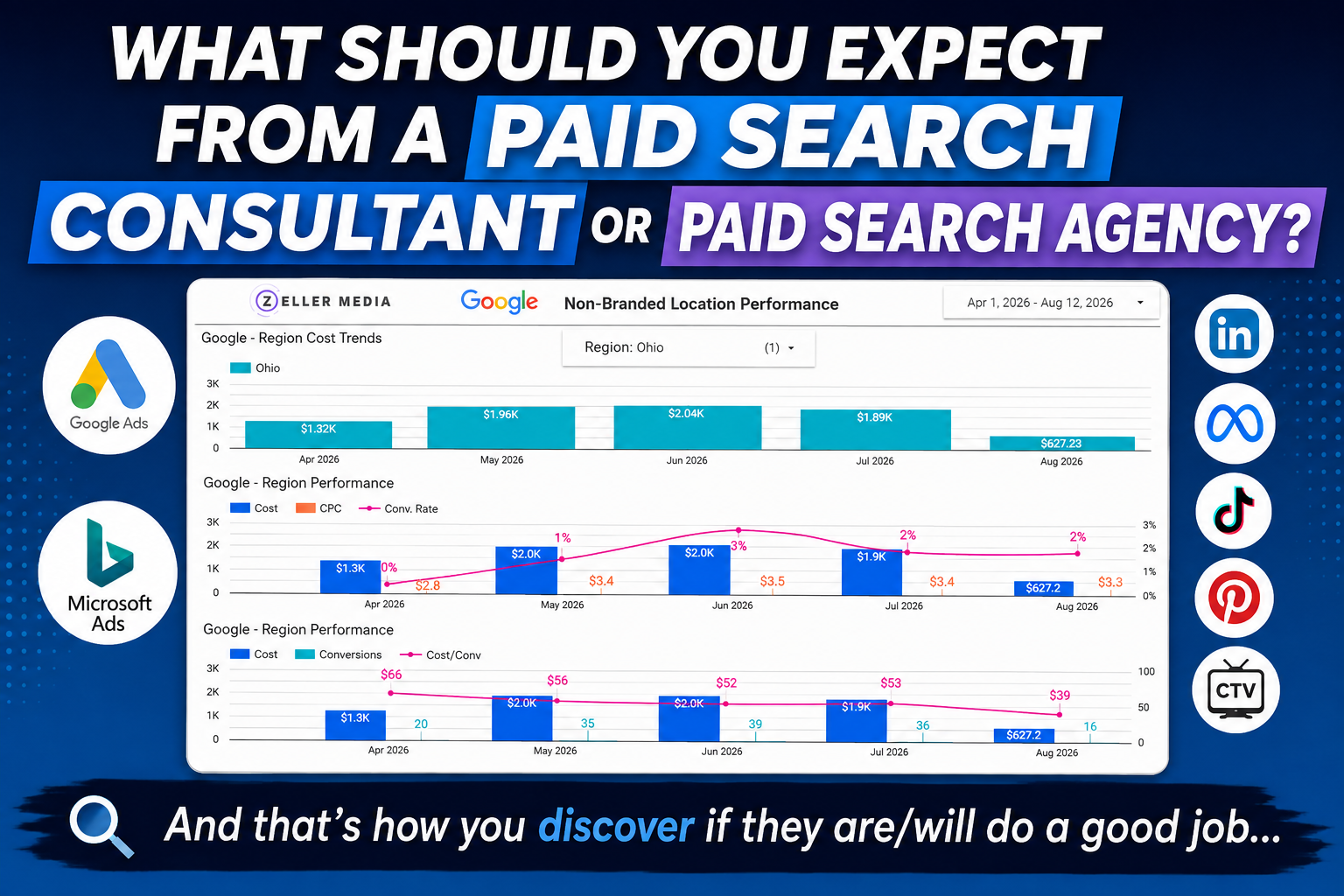
There’s a question most business owners never think to ask their Google Ads agency: what did you actually do this month? Not what did the dashboard say. Not what the automated report summarized. What did a human being inside your account physically do to protect your budget, improve your efficiency, and move the needle on real business outcomes? If your agency can’t answer that clearly, you’re probably losing money. And you’re not alone. After 15 years in the paid media space — including time at Havas, MediaCom, and Starcom managing $100M+ in annual ad spend — I’ve audited dozens of accounts that were “managed” by agencies. The patterns are remarkably consistent. Here’s what I see over and over again.
They Don’t Pull Search Query Reports
This is the single biggest tell. Search query reporting is where you find out what people actually typed before clicking your ad. It’s where you discover that your “personal injury lawyer” campaign is getting clicks from people searching “how to become a personal injury lawyer” or “personal injury lawyer salary.” Those clicks cost real money. And they will never convert. A good paid search consultant pulls search term reports regularly, extracts negative keywords, refines match types, and eliminates irrelevant traffic. It is foundational cost control. When agencies skip it — and most do — accounts slowly bleed budget on searches that have zero commercial intent.
If your agency has never walked you through a search query report, they are not managing your account. They are babysitting it.
They Don’t Pace Budget Properly
Budget pacing is not a month-end activity. It’s ongoing financial discipline. Every month, spend should be monitored at the campaign level: month-to-date spend vs. target, yesterday’s delivery, platform-level distribution, and allocation alignment. I actively look for campaigns that are underdelivering, overspending, or drifting from strategic targets. When agencies don’t pace properly, one of two things happens. Either the budget burns out by the 20th of the month and your campaigns go dark for ten days, or spend is so conservative that you leave opportunity on the table. Both are failures. Paid media is capital allocation. It deserves the same discipline you’d apply to any other investment — whether you’re running Google Ads, Microsoft Ads, or Meta.
If you discover pacing problems in the last week of the month, it’s already too late.
They Let Smart Bidding Run Unsupervised
Smart bidding is powerful. It is not self-governing. Agencies love to set a Target CPA or Target ROAS bid strategy and walk away, because the platform is “optimizing automatically.” But algorithms optimize based on the inputs they receive. If conversion tracking is flawed, if the objective is misaligned, or if the learning phase never stabilizes, automation accelerates the wrong outcome. I regularly review bid strategies to ensure they align with actual performance data. That includes evaluating whether CPA targets are realistic given current volume, whether the learning phase is stable, whether conversion integrity is solid, and whether the account is sacrificing volume for efficiency or vice versa.
Automation is leverage. It still requires oversight.
They Ignore Brand Campaign Performance
Brand campaigns are often treated like background noise — set them up once and forget about them. That’s a mistake. I monitor impression share, competitor overlap, CPC trends, and top-of-page rate for every brand campaign. If competitors start entering your brand auction aggressively and nobody notices, you lose margin without realizing it. Your cost per branded click creeps up. Your impression share drops. And your most efficient traffic source quietly degrades. Brand protection is defensive strategy. It safeguards the economics of the entire account.
Ignoring brand performance is negligence.
They Don’t Monitor Competitors
Paid media exists in an auction. Auctions have competitors. I monitor competitor keyword shifts using tools like SpyFu. I analyze creative angles, messaging trends, offer structures, and funnel positioning. I watch for strategic shifts before they become obvious — because by the time a competitor’s move is visible in your performance data, you’ve already lost ground. Agencies that never mention your competitors in reporting calls are not doing competitive intelligence. They’re managing in a vacuum.
If you don’t understand what your competitors are testing, you’re reacting instead of anticipating.
They Report Vanity Metrics
Here’s a test: look at your last monthly report. Does it lead with impressions, clicks, and CTR? Or does it lead with cost per qualified lead, pipeline revenue, and return on ad spend? If it’s the former, your agency is decorating. Impressions don’t pay your bills. Clicks don’t close deals. A report that doesn’t connect ad spend to actual business outcomes is not a report — it’s a screenshot with a logo on it. At Zeller Media, every report answers one question: what are we doing differently next month? If a report doesn’t drive action, it’s decoration.
Reporting should change behavior, not just confirm activity.
They Never Touch Your Landing Pages
Your ads don’t matter if your landing pages leak. Most agencies treat their job as ending at the click. But the click is where the work starts. If the landing page doesn’t convert, you’re paying for traffic that evaporates. I look at conversion and funnel optimization as part of the system — not a separate workstream someone else handles. That means auditing landing page load times, form completion rates, mobile experience, message match between ad copy and page content, and whether the CTA actually makes sense for the offer. A marginal improvement in landing page conversion rate compounds across every dollar of ad spend.
The best ad in the world can’t fix a broken funnel.
They Don’t Fix Tracking
Most performance issues are tracking issues. I audit and fix paid search tracking, validate conversion events, test lead flows, ensure CRM integration integrity, and monitor Merchant Center implementations. If tracking is broken, performance data is fiction. No consultant can scale what they cannot measure. The scariest version of this is when tracking looks fine on the surface but is actually double-counting conversions, missing offline events, or attributing leads to the wrong campaigns. That means every optimization decision is being made on bad data.
Broken tracking doesn’t just hide problems. It creates fake confidence.
How to Tell If This Is Happening to You
Ask your agency these questions: When was the last time you pulled a search query report for my campaigns? What negative keywords have you added this month? How is my budget pacing against target right now? What bid strategy changes have you made recently and why? Are any competitors bidding on my brand terms? What is my cost per qualified lead — not cost per click, cost per qualified lead? When was the last time you audited my conversion tracking? If the answers are vague, delayed, or deflected, you don’t have a management problem. You have a trust problem.
What Real Management Looks Like
At Zeller Media, paid media is treated like a living system. That means budget pacing is monitored continuously, search queries are reviewed regularly, bid strategies are checked against real data, competitors are tracked, creative is tested, tracking is audited, and reporting drives action — not just documentation. No layers. No junior staff. No handoffs. When you work with me, you get the operator — not an account manager who needs to “check with the team.” If you want to know whether your current agency is actually doing their job, book an audit. I’ll open the account, show you what’s happening, and give you a plan to fix it — whether you hire me or not.
That’s the difference between management and maintenance.